Fujitsu launches notebooks with solid state drives
Fujitsu Computer Systems Corp. introduced two touchscreen notebook PCs today that are available with custom-ordered solid state drives (SSD) of 16GB or 32GB.
The Life Book P1610, a convertible notebook, and the Life Book B6210, a clamshell style, can each be converted to run the flash-based SSDs. The 16GB SSD is priced at $700, and the 32GB is priced at $1,300, said Paul Moore, senior director of mobile marketing at Fujitsu in Sunnyvale, Calif.
Fujitsu will give credit to business customers for the cost of replacing a hard drive with an SSD, Moore said, which could be about $250 for an 80GB hard drive, he said. A P1610 with a 30GB hard drive has a starting price of $1,649. The SSD, manufactured by Samsung, will take up the same space in the laptop as the hard drive, he said.

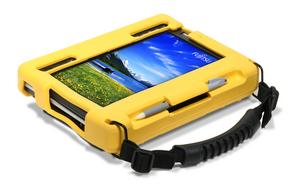
The Fujitsu P1610 can be converted to run a solid state drive.
SSDs will be popular for job settings where data protection is important, such as a stock trader or a health care worker, Moore said. "If a PC crashes, you want to protect the drive and data," he said. SSDs also don't use as much power and don't produce much heat or noise and require a shorter boot time, he added.
Fujitsu said it believes it is the first to offer a touchscreen notebook with SSD, although Moore said there are some small Windows CE computers running SSD.
Roger Kay, an analyst at Endpoint Technologies Associates Inc. in Framingham, Mass., said Fujitsu might be the first of its type, although a hybrid SSD-hard drive laptop is being sold in Asia.
"Solid state drives are definitely the wave of the future," Kay said. "They're fantastically cool, but fairly expensive. Once flash storage prices come down to reasonable levels, SSD will take off."
In addition to higher cost, SSDs have significantly less read/write life than a hard drive. "Still, the read/write durability is pretty good and more than most people would need," he said.
The biggest benefit will be "substantial power savings," he added.
Fujitsu also announced a rugged case for each notebook, priced at $139, Moore said.
The P1610 is 2.2 pounds, with an 8.9-inch touchsreen, while the B6210 is 3.2 pounds with a 12.1 inch display. The B6210 runs Windows XP Tablet PC Edition 2005 or Windows XP Pro, while the P1610 runs those two or Windows Vista Business Edition.
Fujitsu launches notebooks with solid state drives
Fujitsu Computer Systems Corp. introduced two touchscreen notebook PCs today that are available with custom-ordered solid state drives (SSD) of 16GB or 32GB.
The Life Book P1610, a convertible notebook, and the Life Book B6210, a clamshell style, can each be converted to run the flash-based SSDs. The 16GB SSD is priced at $700, and the 32GB is priced at $1,300, said Paul Moore, senior director of mobile marketing at Fujitsu in Sunnyvale, Calif.
Fujitsu will give credit to business customers for the cost of replacing a hard drive with an SSD, Moore said, which could be about $250 for an 80GB hard drive, he said. A P1610 with a 30GB hard drive has a starting price of $1,649. The SSD, manufactured by Samsung, will take up the same space in the laptop as the hard drive, he said.
The Fujitsu P1610 can be converted to run a solid state drive.
SSDs will be popular for job settings where data protection is important, such as a stock trader or a health care worker, Moore said. "If a PC crashes, you want to protect the drive and data," he said. SSDs also don't use as much power and don't produce much heat or noise and require a shorter boot time, he added.
Fujitsu said it believes it is the first to offer a touchscreen notebook with SSD, although Moore said there are some small Windows CE computers running SSD.
Roger Kay, an analyst at Endpoint Technologies Associates Inc. in Framingham, Mass., said Fujitsu might be the first of its type, although a hybrid SSD-hard drive laptop is being sold in Asia.
"Solid state drives are definitely the wave of the future," Kay said. "They're fantastically cool, but fairly expensive. Once flash storage prices come down to reasonable levels, SSD will take off."
In addition to higher cost, SSDs have significantly less read/write life than a hard drive. "Still, the read/write durability is pretty good and more than most people would need," he said.
The biggest benefit will be "substantial power savings," he added.
Fujitsu also announced a rugged case for each notebook, priced at $139, Moore said.
The P1610 is 2.2 pounds, with an 8.9-inch touchsreen, while the B6210 is 3.2 pounds with a 12.1 inch display. The B6210 runs Windows XP Tablet PC Edition 2005 or Windows XP Pro, while the P1610 runs those two or Windows Vista Business Edition.
Fujitsu First to Offer Solid State Drives in Its Pen-Enabled LifeBook Notebooks for Optimal Performance and Data Protection
Fujitsu Computer Systems Corporation today introduced the first pen-enabled notebooks with solid state drives (SSDs). The LifeBook® P1610 and LifeBook B6210 ultra-portables will offer an option for an SSD, an advanced NAND flash-based replacement for traditional hard disk drives. Fujitsu also introduced a rugged case for added durability and reliability. The rugged-enhanced notebooks, designed for optimal portability and data protection, are ideal for medium-sized and large organizations within vertical markets, including healthcare, aviation, and field service, which require a light and compact, but highly durable mobile computer.
The 2.2-pound LifeBook P1610 convertible touch screen notebook and 3.2-pound LifeBook B6210 touch screen notebook are now offered with two flash-based SSD configurations, 16 GB or 32 GB. SSDs offer lower power consumption, added ruggedness, high reliability, and improved performance.
In addition to providing significantly more durability and data protection than traditional hard disk drives, there are no moving parts to fail or heads to crash. SSDs are noise free, generate virtually no heat and weigh half as much as traditional notebook hard drives.
SSDs also offer faster performance and quicker boot-up time because data access is virtually instantaneous. Unlike traditional hard disk drives there is no need to spin the platters up to speed, no seek time, and no rotational latency. SSDs also read two times faster and write up to 60% faster than other hard drives. In addition to the added durability all of this translates to a much faster experience and longer battery life.
The LifeBook P1610 notebook and its predecessor, the LifeBook P1510 notebook, can be further fortified in tablet mode with an optional 3/4-inch thick flexible Santoprene case. The case, which provides access to all ports, offers additional protection against accidental drops, bumps and the rigors of a day on the road.
"On-your-feet workers need to protect their tools without interfering with the product's usability or adding significant cost," said Paul Moore, senior director of mobile product marketing, Fujitsu Computer Systems. "By offering SSDs along with rugged cases, Fujitsu provides a superior solution for environments where rough handling of notebooks is inherent in the workplace."
The LifeBook P1610 convertible notebook, a light-weight powerhouse packed with full PC functionality and an 8.9-inch indoor/outdoor touch screen, is designed for on-the-go mobile professionals who require the flexibility of a tablet for note-taking or navigating through forms-based applications, along with the traditional keyboard input of a notebook computer. The LifeBook B6210 notebook, popular in fast-paced, forms-intensive workplaces, is equipped with a bright 12.1-inch XGA display offering the flexibility of touch screen input and the productivity of a notebook computer.
Price and Availability
The SSD for the LifeBook P1610 and B6210 notebooks will be offered with 16GB and 32GB storage capacities and available to corporate customers and agencies on a project-basis. Contact computers@us.fujitsu.com or 1-800-831-3183 for pricing and availability. The rugged tablet case for the LifeBook P1610 and LifeBook P1510 notebooks, priced at $139(1), is available through the Fujitsu direct sales force, website and channel partners.
Service and Support
The Fujitsu LifeBook P1610 and B6210 notebooks are backed by a one- or three-year International Limited Warranty for U.S. and Canadian customers. The International Limited Warranty(2) includes technical support, 24 hours a day, seven days a week(3), and unlimited online chat support. In addition, Fujitsu offers other warranty plans designed to meet the unique needs of mobile users. See http://us.fujitsu.com/computers for further information.
Samsung Digital Picture Frames Get Wi-Fi
Samsung Electronics Co. Ltd. this week showed off a soon-to-be-released version of its digital photo frame with Wi-Fi and two larger versions that will hit markets later this year.
Samsung displayed unreleased 12-inch and 8-inch versions of the company's digital photo frames, alongside a 7-inch version of the frame that can connect with a PC over Wi-Fi. The displays were on display at the Cebit trade show in Hanover, Germany.
The €229 (US$305) SPH-72P, which hits European markets in May, uses Wi-Fi to automatically discover and connect with PCs running Microsoft Corp.'s Windows Vista operating system and can display photos stored in Windows Media Player 11.
Like the €179 SPH-72H model, which does not have Wi-Fi and will hit European markets at the same time, the SPH-72P has a four-in-one memory card reader and a USB port that can connect directly to a digital camera or portable hard disk.
Both picture frames have a 7-inch screen that offers a resolution of 800 pixels by 480 pixels, and they can play MP3 files and movie clips.
The SPH-72P can also display JPEG photos downloaded by RSS (Really Simple Syndication) from Web sites, such as Windows Live Spaces. But a Samsung sales executive manning the company's booth said photo frames sold in Europe may not initially support this feature.
Samsung plans to ship the 8-inch and 12-inch versions later this year, and they could be on the market during the third quarter, the sales executive said. Detailed specifications of the larger photo frames were not available.
Fujitsu Puts Flash on Laptops
Fujitsu is fortifying two models in its notebook line by offering the option of solid state drives for rugged applications like health care and aviation, the company said today.
Fujitsu is offering flash memory on its LifeBook P1610 and B6210 models, both touchscreen, ultra-portable notebooks. It will continue to sell them with their current design of hard disk drives. The company began offering flash memory on some of its P-series and Q-series notebooks in Japan two months ago, but this is the first time the feature will reach North America.
Customers will have to pay more for NAND flash memory than traditional spinning magnetic drives, but they will gain benefits like reduced power consumption, lower latency with data traffic, faster boot times, and reduced noise, heat and weight, said Paul Moore, Fujitsu's senior director of mobile product marketing.
Flash Advances
Although flash memory is popular on handheld devices like smartphones and MP3 music players, it has generally been viewed as too expensive for mass-market notebooks. But in recent months, flash prices have been falling and storage capacity rising so fast that several vendors are now considering it for new applications.
Last week Apple declined to comment on rumors that it would soon offer a flash-based "subnotebook." And Intel plans to embed flash storage on motherboards as part of the next-generation Centrino notebook platform it will launch in the second half of 2007.
Flash prices will continue to drop sharply over the coming year, following the model of USB-compatible memory sticks, Moore said. Choosing the 16GB flash drive option adds $700 to the price of notebook, and choosing the 32GB flash drive adds $1200. But that disparity won't last long.
"Once they get the dies made and start cranking them out, it's like printing stamps. It's just supply and demand. Today it would be cheaper to buy an SL Mercedes than a 200G-byte solid state drive," Moore said. "Give it a couple years, and everybody's going to be walking around with these. Then your biggest concern is going to be breaking your display."
Fujitsu's Options
Another drawback to flash memory is its limited capacity. Fujitsu is offering a choice of 16GB or 32GB flash drives, compared to the range of 30GB to 80GB it sells in hard drive models. But Moore said customers in finance or medicine can live with that restriction because a flash drive will preserve their data if they drop the notebook, and IT administrators often boost security by storing valuable files on a networked server instead of portable notebook.
Fujitsu did not list prices, since it is selling the notebooks only on a project basis as customers ask for them. The LifeBook P1610 weighs 2.2 pounds, has an 8.9-inch screen, and uses a 1.2GHz Intel Core Solo U1400 processor to run Windows Vista Business, XP Professional or XP Tablet PC Edition. The B6210 weighs 3.2 pounds, has a 12.1-inch screen, and uses the same chip to run Windows XP Tablet PC Edition or XP Professional.
Samsung Releases Improved UMPC, the Q1 Ultra

Samsung Electronics' tiny Q1 Ultra computer drew a lot of attention at the CeBIT 2007 computer expo in Hanover, Germany, last week. Its success there is an indication of the inroads that Samsung's devices have been making in overseas markets.
The Q1 Ultra is a next-generation UMPC, or ultra mobile personal computer, that Samsung developed with Intel and Microsoft. Samsung released the Q1 at CeBIT 2006. For the Ultra it added a keypad and improved some of the Q1's weak points including short battery life and a low-resolution screen so that the Ultra offers PC-style functionality for mobile users.
The Q1 Ultra features an 0.3 mega-pixel web camera on the front side and a 1.3 mega-pixel camera on the flip side. It's also got a QWERTY keypad to the right and left of the screen. Samsung says the device will work for 3.5 hours with the standard four-cell battery or for more than six hours on an extended six-cell battery. The weight was reduced from 760g to 690g.
UMPCs occupy a category between laptops and personal digital assistants (PDAs) and can perform all the functions of a PC both indoors and outdoors. PDAs are light and small but their capabilities are limited, and laptop PCs are too big to carry. The Q1 sold for about W1 million (US$1=W945) but was perceived as pricey. Samsung said the Q1 Ultra, with its improved features, would cost about the same.